Loading project details.
Indoteknik
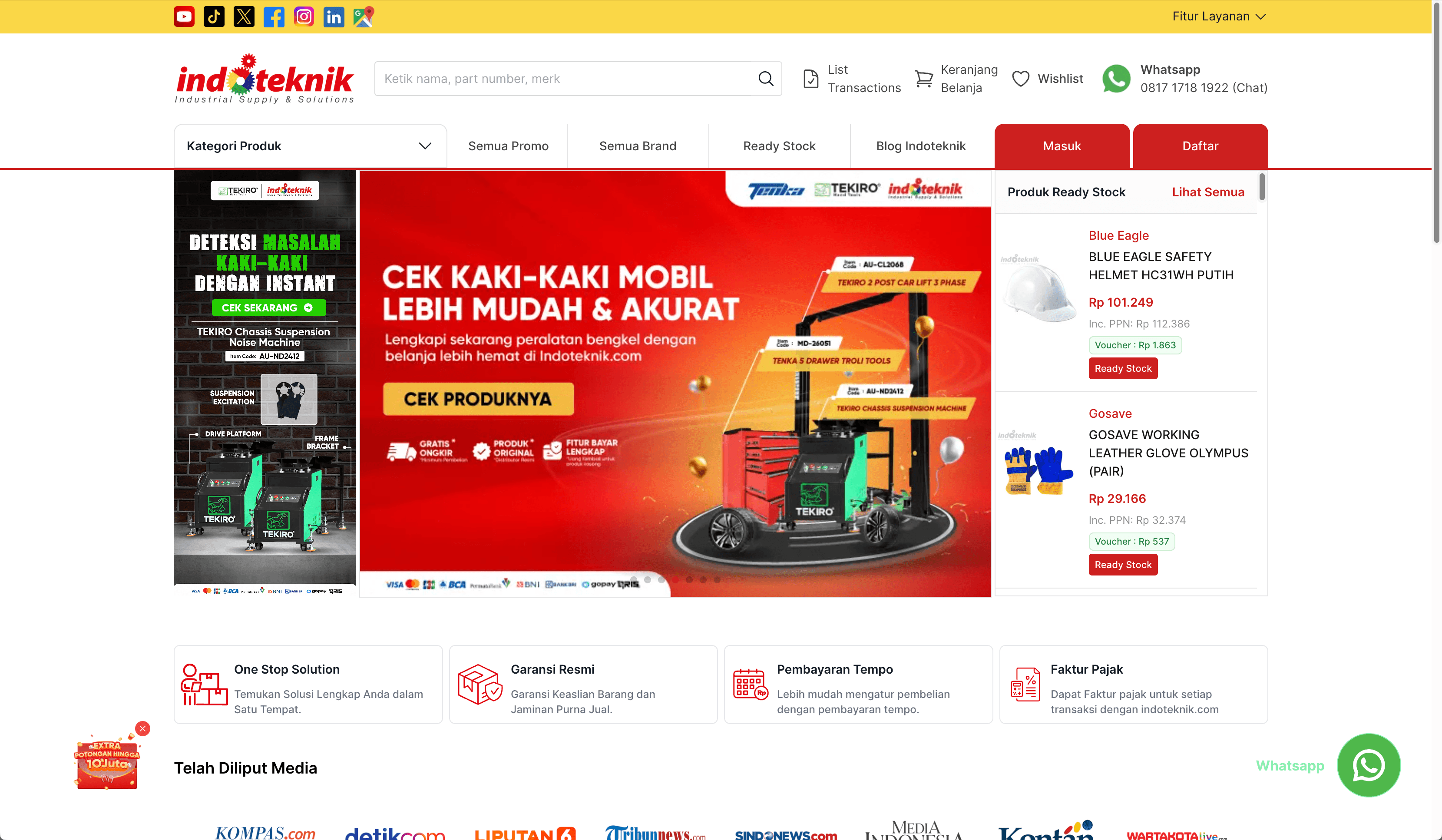
Migrated a legacy online store to Next.js, connecting commerce to Odoo ERP, product search, caching, and background synchronization.
Context & problem
The CodeIgniter storefront was difficult to change alongside ERP catalog and inventory workflows. I proposed moving the storefront to Next.js while retaining Odoo for product, stock, and order rules.
Outcome
The store supports product search and ERP stock updates, with caching to reduce direct ERP requests.
Engineering decisions
Led the migration to a Next.js storefront backed by a custom Odoo API. Kept product search in SOLR, added caching to reduce ERP load during campaign traffic, and used background processing for synchronization so browsing did not have to perform every update.
My contribution
Led the Next.js migration and maintained the APIs connecting the store to Odoo.
Designed and maintained custom API layers over Odoo ERP to isolate business logic from presentation and external traffic spikes.
Introduced caching to reduce direct ERP dependency during campaign traffic spikes.
Maintained SOLR indexing pipelines for product search and catalog updates.
Built internal stock opname tools and synchronization flows to keep inventory data consistent across ecommerce and ERP systems.
Structured background synchronization flows to prevent race conditions between ERP updates and storefront visibility across services.
Trade-offs
- Balanced performance optimizations with ERP consistency constraints.
- Avoided premature microservice fragmentation to reduce operational complexity and hidden coupling.